
Autumn & Thanksgiving
Thanksgiving Dinner Traditions: Where Each Dish Began
Where it comes from: Most Thanksgiving dinner traditions were written down long after the colonial era. Cranberry sauce with turkey first appears in a 1796 American cookbook, the turkey at the head of the table and pumpkin pie in an 1827 novel, marshmallow sweet potatoes in a 1917 booklet, and green bean casserole in a 1955 company kitchen.
Start with a small surprise for the next person who carves: the first printed advice to serve turkey with cranberry sauce is 67 years older than the national holiday. It sits in Amelia Simmons’s American Cookery, printed in Hartford in 1796, at the end of a roast turkey recipe that says “serve up with boiled onions and cramberry-sauce”, spelling and all, in the Project Gutenberg transcription of the book.
Most dishes on a modern Thanksgiving table arrived one at a time, from cookbooks, a novelist with a cause and two food companies. The date is a separate story: Congress fixed the fourth Thursday of November in 1941, as told in our guide to where the holiday and its customs began. This post stays at the table. Which dish on your plate is the oldest?
- 1455: Johannes Hartlieb records people reading the coming winter from a goose’s forked breastbone, per the Wikipedia entry on the furcula.
- 1598: “merrythought”, the old English name for the wishbone, gets its earliest dictionary citation, as reported by Slate.
- 1796: American Cookery prints turkey stuffings, cranberry sauce for roast turkey and two pumpkin puddings in a crust.
- 1827: Sarah Josepha Hale’s novel Northwood sets the roast turkey “at the head of the table” and calls pumpkin pie indispensable.
- 1917: a marshmallow company’s recipe booklet gives the first documented sweet potatoes baked under marshmallows, according to the Library of Congress.
- 1955: Dorcas Reilly writes the “Green Bean Bake” in the Campbell Soup Company test kitchen in Camden, New Jersey.
Why do people eat turkey on Thanksgiving?
Because a turkey is big enough to feed a crowd, is native to North America, where more than 10 million wild birds once lived according to History.com, and was placed at the center of the meal by the writers who shaped the holiday. By 1857, turkey had become part of the traditional New England dinner, according to the Wikipedia entry on Thanksgiving dinner.
Sarah Josepha Hale did the most work. In her 1827 novel Northwood, “the roasted turkey took precedence on this occasion, being placed at the head of the table”, sending out “the rich odor of its savory stuffing”, as quoted by The Saturday Evening Post. Her fictional feast also held beef, pork and mutton.
Size and supply did the rest. Anthropologist Elan Abrell of Wesleyan University told History.com that the bird rose through “cultural advocacy and technological innovations”, not a founding meal. The National Turkey Federation puts the holiday total at more than 46 million birds a year, as reported by History.com, and a YouGov poll of 1,595 adults taken in November 2024 found that 67% planned to eat turkey.
So about a third of adults in that poll planned no turkey at all. What sits in the middle of your table?
Where does the wishbone tradition come from?
The wishbone tradition comes from medieval and early modern Europe, where people first read signs in a bird’s forked breastbone and later pulled it apart for luck. The earliest record is a goose-bone weather forecast from 1455, and the two-person pull dates to the early 1600s, according to the Wikipedia entry on the furcula.
In Hartlieb’s account, once the goose had been eaten on St. Martin’s Day, the oldest person present examined the bone to judge whether the winter would be severe or mild. That is fortune-telling, not wishing. English speakers called the bone a merrythought, a word the Oxford English Dictionary first finds in 1598, while “wishbone” first appears in John Russell Bartlett’s 1859 Dictionary of Americanisms, both as reported by Slate.
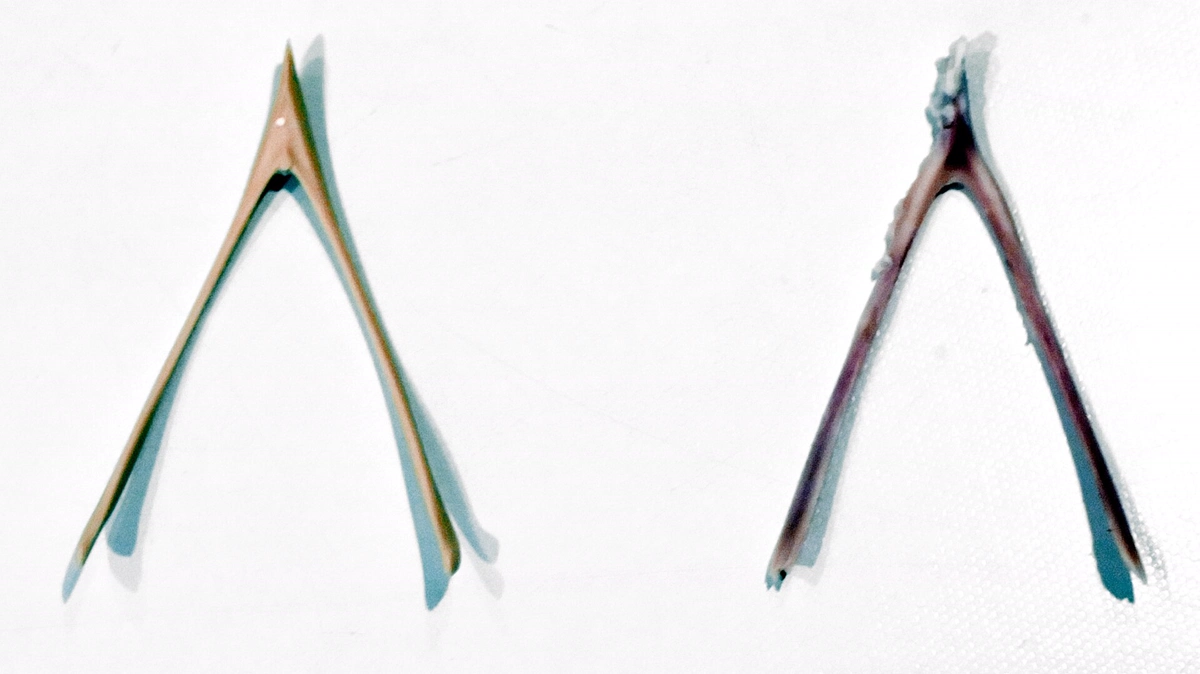
You may have read that the custom began with Etruscans stroking dried chicken bones, and that Romans started breaking them because there were too few. None of the reference works checked for this post gives an ancient source for that story, so it is labeled unverified here. Which half wins at your table?
Why is cranberry sauce served with turkey?
Because the first known cookbook by an American author told cooks to serve it that way. Amelia Simmons ended her 1796 roast turkey recipe with boiled onions and cranberry sauce, and the pairing stayed as the turkey became the holiday centerpiece. Cranberries also ripen in autumn, so the berry was already on the calendar.
Simmons also baked the berry: her cranberry entry says to stew, strain and sweeten it, then bake it gently in a crust. The American Cookery entry on Wikipedia counts 13 known editions between 1796 and 1831, so her advice travelled for a generation.
The can arrived much later: the first commercial cranberry sauce was made in Hanson, Massachusetts, in 1912, and canned sauce went on sale nationwide in 1941, per the Wikipedia history of cranberry sauce. The harvest behind it is striking: growers flood the beds with 6 to 8 inches of water so the ripe berries float and can be gathered, according to the Wikipedia entry on the cranberry, and Wisconsin grew 59% of the United States crop as of 2021.
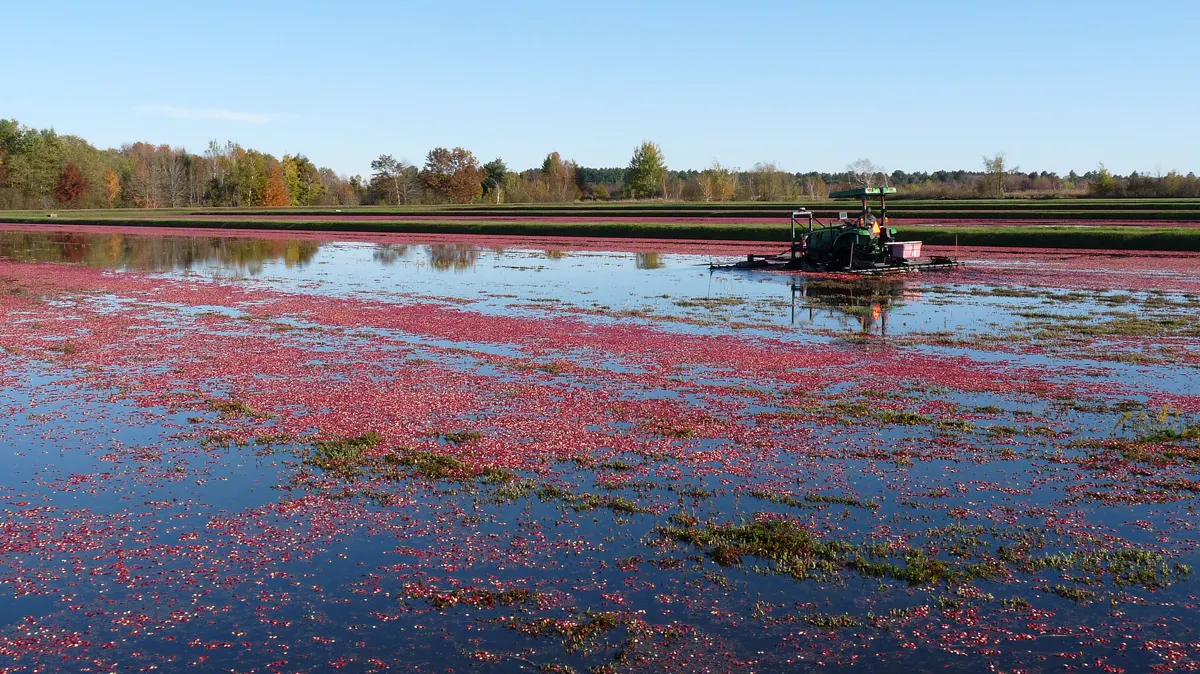
One autumn nearly broke the custom: on 9 November 1959, federal health officials announced traces of a weed killer on some cranberries, and the market crashed, the same entry reports. Would your family have skipped the sauce?
Why is pumpkin pie the Thanksgiving dessert?
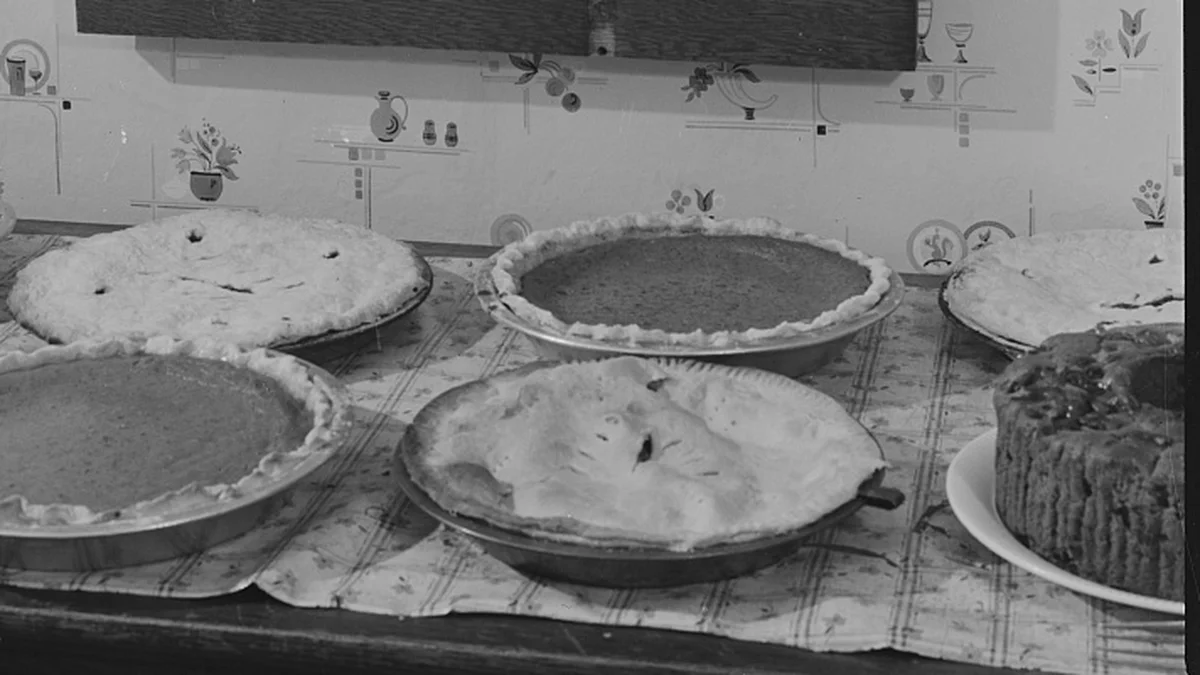
Pumpkin pie became the Thanksgiving dessert in New England in the early 1800s, after cookbooks printed custard versions and writers tied it to the holiday. Sarah Josepha Hale called it “an indispensable part of a good and true Yankee Thanksgiving” in 1827, per the Wikipedia entry on Thanksgiving dinner, and the idea spread with her campaign.
The pie itself is older than the colonies. La Varenne printed a pumpkin pie in France in 1651, and English cooks of the 1670s baked fried pumpkin slices in a crust with sugar and raisins, per the Wikipedia history of pumpkin pie. Simmons gives two pumpkin recipes in 1796: one with cream, eggs, mace, nutmeg and ginger, the other with milk, molasses, allspice and ginger, each baked in a crust.
The dessert also carried regional meaning. After the Civil War, some Southern cooks treated pumpkin pie as a Yankee symbol and baked sweet potato pie instead, the same entry notes. In Northwood, the pumpkin pie “occupied the most distinguished niche”. Which pie gets that niche at yours?
Where did green bean casserole and stuffing come from?
Stuffing is ancient and green bean casserole is modern. Stuffed birds appear in the Roman cookbook attributed to Apicius, the earliest documentary evidence for stuffing, while green bean casserole was created in 1955 by Dorcas Reilly in the Campbell Soup Company kitchen, according to their Wikipedia entries.
The filling was called “stuffing” by 1538 and “dressing” from 1850, the word that caught on in the United States, per the Wikipedia entry on stuffing. Simmons’s 1796 turkey stuffing used grated bread, salt pork, eggs, marjoram, savory, parsley and sage, a herb list that still looks familiar. In the South, dressing is generally made from cornbread instead, the Wikipedia entry on Thanksgiving dinner adds.
Family menus show how firmly these sides set. One person answering a reader question remembered a table that has barely changed: turkey with cornbread dressing cooked in the bird, giblet gravy, marshmallow sweet potatoes, green bean casserole and ambrosia salad, in their published answer.
The casserole began with a newspaper request. An Associated Press writer asked for a quick vegetable side from pantry staples, and Reilly’s team answered with six ingredients led by green beans, mushroom soup and fried onions, per the company’s own history page. It became a holiday fixture in the 1960s, after the recipe went onto soup can labels, according to Wikipedia. The company estimated in 2020 that it appears at 20 million Thanksgiving dinners a year, the same entry reports.
The marshmallow topping on sweet potatoes is a marketing story too. In 1917, the makers of Angelus Marshmallows hired Janet McKenzie Hill, founder of the Boston Cooking School Magazine, to write a recipe booklet, and it “contained the first documented appearance of mashed sweet potatoes baked with a marshmallow topping”, according to the Library of Congress. Does a company origin make a dish less traditional, or only newer?
Why do families say what they are thankful for at the table?
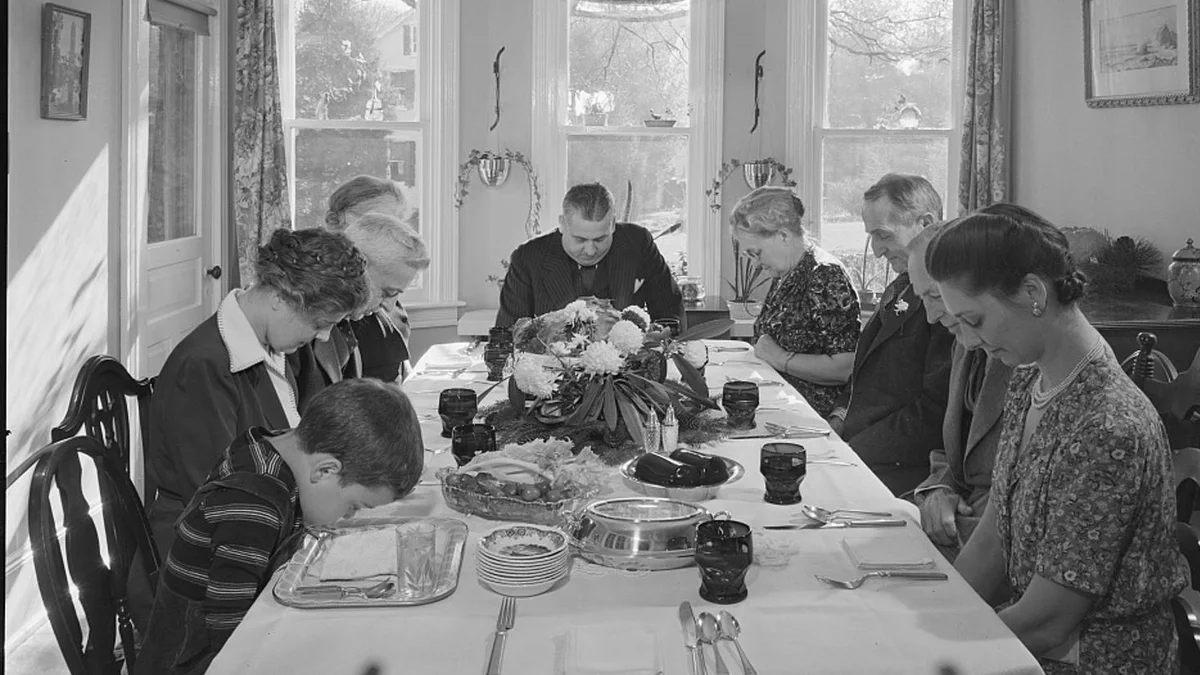
Because a day of thanksgiving is, by its name, a day for saying thanks out loud, and the habit is now common at home. In a Pew Research Center survey of 9,609 adults taken in November 2024, 69% said someone at their dinner typically says what they are thankful for, 65% said someone offers a prayer or blessing, and 56% said both happen.
- Across beliefs: 61% of agnostics and 48% of atheists in that survey still hear thanks spoken at the table.
- The five kernels: at the Forefathers’ Day dinner in Plymouth in 1820, “five kernels of parched corn” were placed on each plate, alluding to a time in 1623 when that was said to be each person’s ration, according to James Thacher’s 1832 History of the Town of Plymouth.
The kernels are the oldest dated table ritual of this kind found for this post, with a warning label: Thacher introduced the ration itself with “it has been stated”, so even in 1832 it was hearsay. Setting food aside before a feast is an old habit elsewhere too, as how other cultures celebrate the harvest shows. When it is your turn to speak, what will you name first?
When were Thanksgiving dinner traditions first written down?
Most were first written down between 1796 and 1955, in a cookbook, a novel, a town history and two company kitchens. The table gives each first documented date and source, how it spread, and how solid the record is.
| Dish or custom | First documented | How it spread | Note |
|---|---|---|---|
| Turkey at the head of the table | 1827, Hale’s novel Northwood | Part of the New England dinner by 1857 (Wikipedia) | Documented |
| Cranberry sauce with turkey | 1796, American Cookery | 13 editions to 1831; canned nationwide from 1941 | Documented |
| Pumpkin pie | 1651 in France; 1796 custard version in American Cookery | Standard New England holiday dessert by the early 1800s | Documented |
| Bread stuffing in the turkey | 1796, American Cookery | “Dressing” spreads as the American word from 1850 | Documented |
| Pulling the wishbone | Early 1600s, England (furcula entry) | “Wishbone” in an American dictionary by 1859 | Documented; ancient origin unverified |
| Five kernels on each plate | 1820, Thacher’s town history | Served at the Plymouth Forefathers’ Day dinner | Ritual documented; the ration is folklore |
| Marshmallow sweet potatoes | 1917, marshmallow company booklet (Library of Congress) | In vegetable cookbooks by 1928 | Documented |
| Green bean casserole | 1955, soup company test kitchen | Printed on soup can labels in the 1960s | Documented |
| Cornbread dressing (South) | No first date in reference sources | Regional default in the South (Wikipedia) | Regional custom |
| Sauerkraut beside the turkey (Baltimore) | No first date; linked to German and Eastern European families (Wikipedia) | Mid-Atlantic tables, especially in Baltimore (Wikipedia) | Regional custom |
| Arroz con gandules and pasteles (Puerto Rico) | No first date (Wikipedia) | Served beside a turkey sometimes stuffed with mofongo | Regional custom |
Regional tables keep their records mostly in living memory. A 2014 Baltimore Fishbowl story quoted chef John Shields calling a turkey without sauerkraut “unthinkable”, and one reader commented under that story that their family serves sauerkraut and corn pudding. The 2024 YouGov poll found regional patterns too: cranberry sauce more likely in the Northeast, ham and macaroni and cheese in the South. For more, browse more autumn customs and where they began. Which row is yours?
Thanksgiving table myths, checked
Food stories travel faster than footnotes. Here, unverified means no reference source supports a claim, unlikely means the record points the other way, and myth means the record contradicts it.
| Claim | What the record shows | Source | Verdict |
|---|---|---|---|
| Cranberry sauce was on the first harvest table | Sugar was scarce and the eyewitness record names no sauce; the earliest pairing with turkey in print is 1796 | Wikipedia, cranberry sauce; American Cookery | Unlikely |
| Pumpkin pie is an American invention | A French recipe dates from 1651 and English pumpkin pies from the 1670s | Wikipedia, pumpkin pie | Myth |
| The wishbone custom is Etruscan | No ancient source found; the earliest bone reading on record is from 1455 | Wikipedia, furcula | Unverified |
| The colonists lived on five kernels of corn a day | Thacher reported it in 1832 as something that “has been stated” | Thacher, History of the Town of Plymouth | Folklore |
| Marshmallow sweet potatoes are an old Southern recipe | First documented in a 1917 booklet written for a marshmallow brand | Library of Congress | Myth |
Want to test a dish yourself? Look for the oldest dated record, not the oldest version of the story.
Tradition trivia
What did people eat for Thanksgiving in the 1800s?
Far more meat than today. Hale’s 1827 novel sets turkey beside beef, pork and mutton, and the White House Cook Book of 1887 opens its Thanksgiving menu with oysters on the half shell and cream of chicken soup before the roast turkey, per the Wikipedia entry on Thanksgiving dinner.
Is it called stuffing or dressing?
Both are correct, and the words date from 1538 and 1850, per the Wikipedia entry on stuffing. Many Southern cooks say dressing and bake it from cornbread, often outside the bird.
How many turkeys do Americans eat at Thanksgiving?
More than 46 million a year, according to the National Turkey Federation figure reported by History.com, as of October 2026. In a November 2024 YouGov poll of 1,595 adults, 67% said they planned to eat turkey.
Who gets the wish when the wishbone breaks?
Usually the person left holding the larger piece, though some families give the wish to the smaller piece, per the Wikipedia entry on the furcula.
Historical claims here come from reference sources, not folklore sites. The draft was prepared with AI, and each claim was re-checked against the reference source before publishing.
Sources: Project Gutenberg, the cookbook transcription; Internet Archive, the town history scan; Library of Congress, sweet potato history; Pew Research Center, holiday survey report; YouGov, holiday food poll; The Saturday Evening Post, holiday history feature; History.com, turkey history; Slate, word history; soup company history page; Wikipedia entries on the holiday meal, the furcula, cranberry sauce, the cranberry, pumpkin pie, stuffing, the casserole and the cookbook.